Most common
LFP
★★★★★
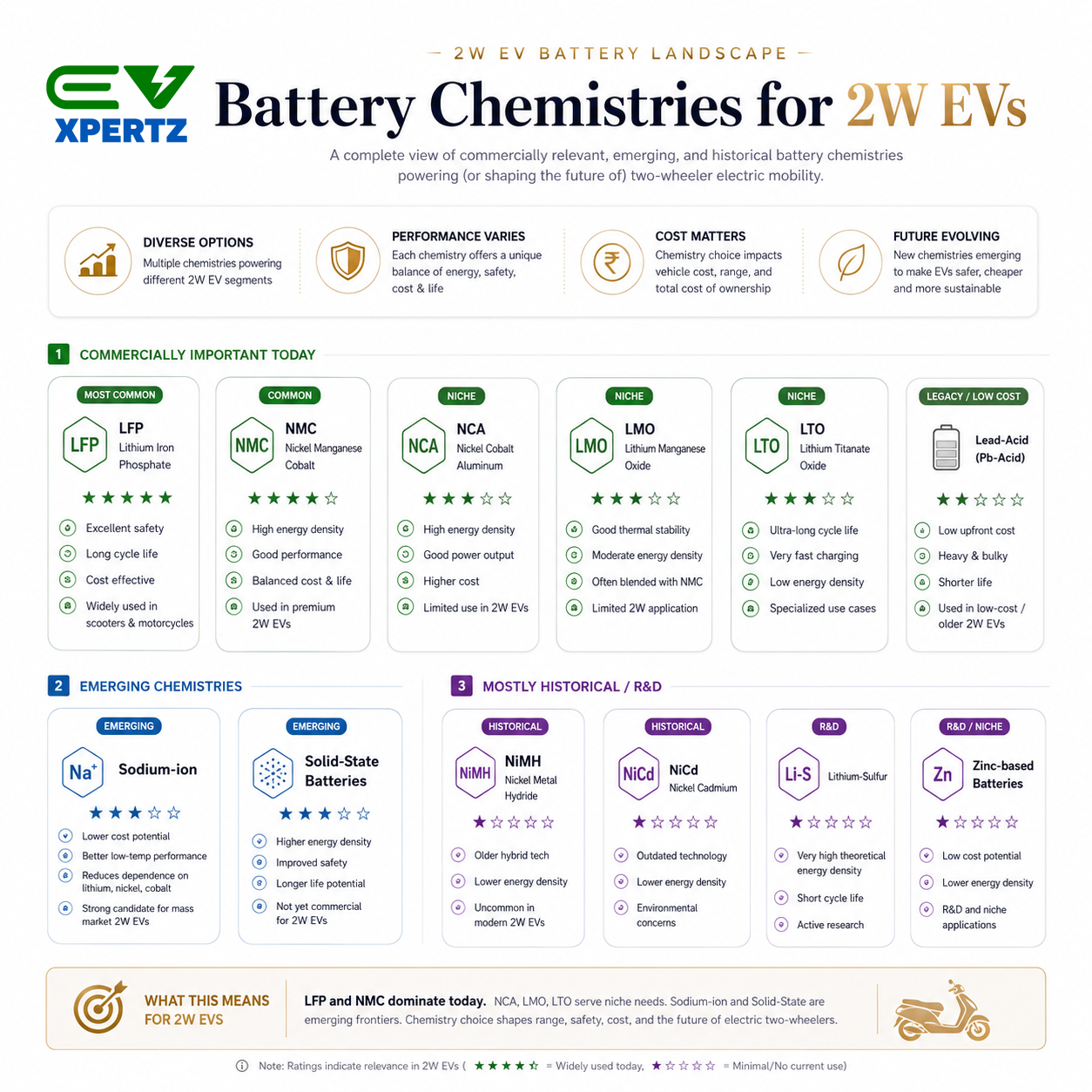
Lithium Iron Phosphate — excellent safety, long cycle life, cost-effective; widely used in scooters & motorcycles.
Battery Intelligence · 2W Chemistry
Don't treat every chemistry as equally prevalent. For diagnostics, service and investor briefings, start with what dominates India's two-wheelers today — then track what's emerging.
LFP and NMC lead. Niche chemistries serve special cases. Emerging tech is a watchlist — not today's fleet default.
Cost, temperature behaviour and less reliance on Li/Ni/Co make Na-ion especially relevant for mass-market 2W EVs.
“Lithium polymer” usually means construction/form factor. Don't park it next to LFP or NMC as an equal category.
BMS limits, failure modes and SoC/SoH methods differ across LFP, NMC, LTO and sodium-ion — that's where EVXPERTZ goes deeper.
Relevance scores reflect typical 2W EV position today (educational). Emerging and R&D items stay below commercial leaders on purpose.
Investor and service decks should overweight commercial chemistries — not pad slides with obsolete options.
Illustrative relative strengths (1–5). Not lab data — a decision frame for mass-market 2W conversations.
What workshops, fleets and dealers actually meet on Indian roads right now.
Lithium Iron Phosphate — excellent safety, long cycle life, cost-effective; widely used in scooters & motorcycles.
Nickel Manganese Cobalt — higher energy density and strong performance; common in premium 2W EVs.
Nickel Cobalt Aluminum — high energy & power; higher cost; limited use in 2W EVs.
Lithium Manganese Oxide — good thermal stability; often blended with NMC; limited standalone 2W use.
Lithium Titanate — ultra-long life & very fast charge; low energy density and costly; specialised cases.
Low upfront cost, heavy & bulky, shorter life — still seen in older / entry-level 2W EVs.
Bottom line: LFP and NMC dominate. Treat NCA, LMO and LTO as application-specific — not the default conversation starter.
Watchlist for product, investment and platform roadmaps — not yet mainstream fleet reality.
Lower cost potential, better low-temp behaviour, and reduced dependence on lithium / nickel / cobalt — a strong candidate for mass-market electric two-wheelers as the supply chain matures.
Higher energy density, improved safety and longer life potential — not yet commercial for mainstream 2W EVs. Track for premium and future platforms.
Why sodium-ion for EVXPERTZ: India's 2W market is volume- and cost-driven. Na-ion's economics and materials story make it worth monitoring alongside LFP — even before wide commercial adoption.
Useful context for completeness — not where day-to-day diagnostics or dealer training should spend time.
Older hybrid tech; lower energy density; uncommon in modern 2W EVs.
Outdated; lower energy density; environmental concerns — essentially obsolete.
Very high theoretical energy density; short cycle life today; active research.
Low-cost potential; lower energy density; not mainstream for 2W traction packs.
“Li-Po” often refers to pouch/polymer cell construction or electrolyte form factor. LFP, NMC, NCA, LMO and similar names describe electrode chemistry. Putting Li-Po beside LFP/NMC as an equal chemistry type confuses training decks and diagnostic trees.
Practical tip: Ask “what cathode chemistry?” and “what cell format?” as separate fields in EVXPERTZ intake, BMS mapping and investor briefs.
Same landscape in one scan — relevance stars mirror the charts above.
| Chemistry | 2W EV relevance | Typical position |
|---|---|---|
| LFP (Lithium Iron Phosphate) | ★★★★★ | Very common; safety, cycle life, cost |
| NMC (Nickel Manganese Cobalt) | ★★★★ | Common; higher energy density |
| NCA (Nickel Cobalt Aluminum) | ★★ | Less common in 2W; technically applicable |
| LMO (Lithium Manganese Oxide) | ★★ | Historical / some blended cells |
| LTO (Lithium Titanate) | ★★ | High cycle life & fast charge; expensive / low Wh/kg |
| Lead-acid | ★★ | Older / low-cost EVs |
| Sodium-ion | 🔬 Emerging | Cost-sensitive mass-market candidate |
| Solid-state | 🔬 Emerging | Future tech; not mainstream today |
| NiMH | ★ | Older hybrids; uncommon in modern 2W |
| NiCd | ★ | Essentially obsolete |
| Lithium-sulfur | 🔬 R&D | High theoretical density; not mainstream |
| Zinc-based | 🔬 R&D / niche | Not mainstream for 2W traction |
| Li-Po (Lithium Polymer) | — | Form factor / construction — not a peer cathode chemistry |
What this means for 2W EV: LFP and NMC dominate today. NCA, LMO and LTO serve niche needs. Sodium-ion and solid-state are emerging frontiers. Chemistry choice shapes range, safety, cost — and how EVXPERTZ should read BMS data.
Star scale: 5 = widely used today · 1 = minimal / no current 2W traction use.
BMS voltage windows, balancing behaviour, thermal limits, SoC estimators and SoH tests are not one-size-fits-all across LFP, NMC, NCA, LTO and sodium-ion. Mapping those differences is more useful than another flat chemistry list.
Pair this landscape with EVXPERTZ battery health FAQs and AI diagnostics when you're building service playbooks or investor narratives.
Start with LFP and NMC, watch sodium-ion for India, and keep R&D chemistries in context — not in the same urgency bucket.