Common EV Controller Failures and Fixes
Diagnosing and Resolving Electric Vehicle Controller Issues in Indian 2W and 3W EVs
Introduction
In the rapidly growing Indian electric vehicle ecosystem, particularly in the 2W and 3W segments, the controller serves as the brain of the vehicle. It governs everything from acceleration and regenerative braking to battery management and motor timing. However, controller failures remain one of the most common yet misunderstood issues among EV owners and fleet operators. With over 1.5 million electric two-wheelers and nearly 1 million e-rickshaws operating on Indian roads today, understanding controller failures is no longer optional—it's essential for minimizing downtime and repair costs.
What is an EV Controller?
The motor controller (often called the VCU or MCU in modern EVs) is an electronic device that regulates the power flow from the battery to the motor based on throttle input. It converts DC from the battery into AC for the motor, controls torque, manages regenerative braking, and interfaces with other vehicle systems. In Indian conditions, controllers face extreme heat, humidity, voltage fluctuations, and dusty environments—making them vulnerable to specific failure modes.
Over 40% of electrical breakdowns in Indian 2W and 3W EVs can be traced back to controller-related issues, according to service data from major OEMs.
Common Signs of Controller Failure
- Vehicle suddenly stops moving while throttle is applied
- Motor runs in jerks or stutters during acceleration
- No response to throttle despite battery showing charge
- Unusual heating of controller casing beyond normal operating temperature
- Burning smell from under the seat or floorboard area
- Regenerative braking not functioning or engaging randomly
- Error codes flashing on dashboard or smartphone app
Controller Failure Due to Overheating
India's ambient temperatures often cross 45°C in summer, pushing controllers to their thermal limits. Most entry-level 2W EVs use passively cooled controllers that rely on aluminum casings for heat dissipation. When combined with stop-start city traffic and continuous high-load operation, internal temperatures can exceed 85°C, leading to thermal shutdown or permanent damage to sensitive components. Fleet operators in Delhi NCR and Chennai report up to 30% higher controller failure rates during May-June compared to winter months.
MOSFET Failure and Short Circuits
MOSFETs (Metal-Oxide-Semiconductor Field-Effect Transistors) are the switching elements inside controllers that handle high currents. When a MOSFET fails—often due to current spikes, poor soldering, or voltage surges—it usually results in a short circuit. This can cause the motor to lock suddenly or the controller to draw excessive current even when stationary. In Indian 3W e-rickshaws operating on lead-acid batteries, voltage fluctuations during charging frequently trigger MOSFET failures, stranding vehicles mid-trip.
Water Ingress and Corrosion Issues
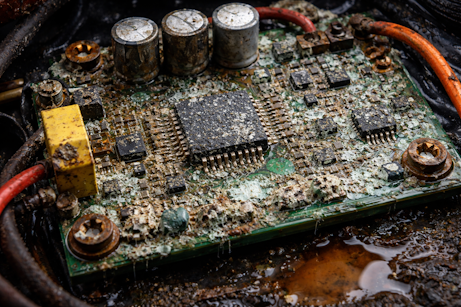
Despite IP ratings, many Indian EVs face water ingress during monsoon or waterlogged roads. The controller connectors and PCB traces are susceptible to corrosion when exposed to moisture. E-rickshaw operators in Kolkata and Mumbai report that water entering controller enclosures through poorly sealed cable glands is the leading cause of controller replacement during rainy seasons. Even minor corrosion can alter resistance values, causing erratic motor behavior.
Throttle and Hall Sensor Signal Problems
Modern controllers rely on Hall effect sensors in the throttle and motor to determine position and speed. Faulty hall sensors—often due to vibration or poor-quality components—send incorrect signals, causing the controller to misbehave. This manifests as sudden acceleration, delayed response, or complete throttle cutout. In high-utilization fleets like delivery services, throttle sensor issues account for nearly 20% of controller-related complaints.
Regenerative Braking Controller Faults
Regen braking systems add complexity to controllers. When regen MOSFETs or control logic fail, it can result in aggressive braking, loss of regen, or in some cases, overvoltage conditions damaging the battery. Indian conditions with frequent braking cycles—especially in e-rickshaws and delivery scooters—accelerate wear on regen-specific components. Some fleet operators in Bangalore have disabled regen entirely through software to reduce controller failures, though this sacrifices range.
Controller Failure in Indian 3W EVs (E-Rickshaws)
The unorganized e-rickshaw sector faces unique controller challenges. Many vehicles use non-standardized controllers paired with mismatched motors and batteries. Overloading—common in passenger e-rickshaws—pushes controllers beyond rated capacity. Additionally, the shift from lead-acid to lithium-ion in FAME II-compliant 3Ws requires controllers with different voltage and communication protocols (CAN vs. analog), leading to compatibility failures when retrofitting or replacing controllers.
| Controller Type | Common Failure Mode | Typical Lifespan | Replacement Cost (INR) |
|---|---|---|---|
| Entry-level 2W (48V sine wave) | MOSFET burnout, overheating | 1.5 - 2 years | 2,500 - 4,500 |
| Premium 2W (72V FOC) | Water ingress, connector corrosion | 3 - 4 years | 8,000 - 15,000 |
| E-rickshaw (lead-acid) | Voltage spike damage, throttle issues | 1 - 1.5 years | 3,000 - 6,000 |
| Lithium 3W (with CAN) | Communication errors, regen faults | 2 - 3 years | 12,000 - 22,000 |
Fleet-Specific Controller Challenges
Fleet operators running 50+ vehicles face controller failure patterns distinct from individual owners. High daily utilization (8-12 hours) means controllers rarely cool down, accelerating thermal fatigue. Swappable battery systems introduce connector wear and voltage transients during battery swaps. Delivery fleets in cities like Pune and Hyderabad report that controller failures account for 35% of unscheduled maintenance downtime, with each failure costing ₹1,500-3,000 in lost revenue per vehicle per day.
FAME II and PMP Policies Impact on Controllers
Government policies like FAME II and state-level EV policies (Delhi EV Policy, Maharashtra EV Policy) mandate specific performance and safety standards. Controllers in FAME II-approved vehicles must meet AIS-156 (now AIS-156 Amendment 3) standards, including vibration resistance, IP ratings, and thermal management. However, post-sales replacement controllers sometimes lack these certifications, leading to premature failures. Fleet owners must ensure replacement controllers comply with OEM specifications to maintain warranty and safety compliance.
We see many cases where customers install cheaper aftermarket controllers to save money, only to face repeated failures and even motor damage. Using OEM-spec controllers is critical for reliability.
Step-by-Step Controller Diagnostics
- Perform visual inspection: Check for burn marks, swollen capacitors, or corroded terminals
- Measure input voltage: Ensure battery voltage reaches controller terminals
- Test throttle signal: Use multimeter to check 0.8V-4.2V variation on throttle signal wire
- Check phase wires: Test continuity between controller and motor phases
- Verify hall sensor signals: Measure 0V-5V pulsing on hall wires while rotating wheel
- Inspect fuses and circuit breakers: Many controllers have internal fuses that blow
- Use diagnostic tool: OEM-specific software or OBD dongle to read error codes
Repair vs. Replacement Cost Analysis
For individual owners, controller replacement often makes more economic sense than repair, especially for entry-level 2Ws where new controllers cost ₹2,500-4,500. However, for premium vehicles with integrated VCUs costing ₹15,000+, component-level repair by specialized technicians can save 60-70% costs. Fleet operators should maintain spare controllers and invest in diagnostic equipment to reduce downtime. Some service centers in Delhi and Pune now offer MOSFET-level repair services for common controller models at ₹800-1,500.
Preventive Maintenance Tips
- Ensure controller mounting area has adequate airflow; avoid covering with storage boxes
- Apply dielectric grease on all connectors to prevent corrosion
- Avoid riding through deep water; if unavoidable, inspect and dry controller afterward
- Use voltage stabilizers if your area experiences frequent grid fluctuations
- Don't overload vehicle beyond rated capacity, especially in e-rickshaws
- Update controller firmware when OEM releases new versions
- Periodically check controller temperature during long rides
When to Seek Professional Help
If diagnostics indicate internal controller damage, or if you lack experience with high-voltage systems, professional assistance is essential. Authorized service centers have programming tools to configure new controllers with vehicle-specific parameters. In metropolitan areas like Bengaluru, Mumbai, and Delhi NCR, specialized EV repair shops now offer controller testing rigs that simulate load conditions to pinpoint failures accurately before recommending replacement.
Conclusion
Controller failures in Indian 2W and 3W EVs are inevitable given the operating conditions, but their frequency and impact can be minimized through understanding, preventive maintenance, and timely diagnostics. As the Indian EV ecosystem matures, controllers are becoming more robust with better thermal management and IP ratings. However, for current vehicle owners and fleet operators, knowledge of common failure modes and practical troubleshooting steps translates directly into reduced downtime and lower ownership costs. At EVXpertz, we recommend building a relationship with reliable service partners and always using quality-certified replacement components to keep your EV running smoothly on Indian roads.